Legal extracts with numbered paragraphs and numbered sub-paragraphs
In some instances in legal extracts, a numbered paragraph may contain numbered sub-paragraphs. Capture the paragraph number and the sub-paragraph number in separate div elements to enforce document hierarchy. The parent div should contain titleGroup and title elements with an enumerator within a p.
A numbered paragraph may contain content that is also enumerated. As per topic Recognising numbered paragraphs and lists in legal documents lists will be indented and enumerated sub-paragraphs are not. When the paragraph number and the sub paragraph number appear on the same line (as with '2.' and 'a.' in the below example) and the sub-paragraphs are not indented, capture the paragraph number and sub paragraph in separate div elements to enforce document hierarchy. The parent div should contain titleGroup and title elements with an enumerator within a p.
      <div3 id="law-9780199778270-chapter-3-div3-3" doi="10.1093/law/9780199778270.003.0003.023.0003">
        <titleGroup id="law-9780199778270-chapter-3-titleGroup-8"><title id="law-9780199778270-chapter-3-title-8">
 <p>Political Power; Object of Government</p></title>
        </titleGroup>
        <p><extract id="law-9780199778270-chapter-3-extract-2" class="USleg" idnumber="OCW CD 1099 (US-nj)" linkType="mentioned" subClass="USconst" title="The Constitution of the State of New Jersey">
 <textMatter id="law-9780199778270-chapter-3-textMatter-3">
   <div1 id="law-9780199778270-chapter-3-div1-1002" doi="10.1093/law/9780199778270.003.0003.021.0001002">
     <titleGroup>
       <title>
         <p>
                                             <enumerator>2.</enumerator>
                                         </p>
       </title>
     </titleGroup>
     <div2 id="law-9780199778270-chapter-3-div2-1001" doi="10.1093/law/9780199778270.003.0003.022.0001001">
       <p>
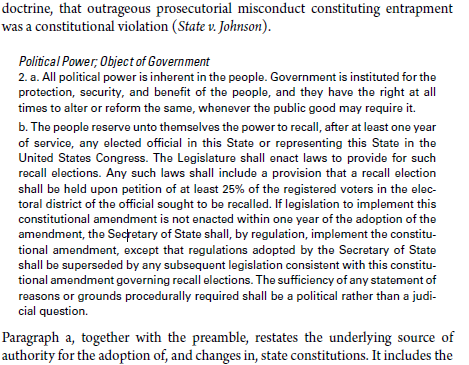
                                         <enumerator>a.</enumerator> All political power is inherent in the people.
                    Government is instituted for the protection, security, and benefit of the
                    people, and they have the right at all times to alter or reform the same,
                    whenever the public good may require it.</p>
     </div2>
     <div2 id="law-9780199778270-chapter-3-div2-1002" doi="10.1093/law/9780199778270.003.0003.022.0001002">
       <p>
                                         <enumerator>b.</enumerator> The people reserve unto themselves the power to
                    recall, after at least one year of service, any elected official in this State
                    or representing this State in the United States Congress. The Legislature shall
                    enact laws to provide for such recall elections. Any such laws shall include a
                    provision that a recall election shall be held upon petition of at least 25% of
                    the registered voters in the electoral district of the official sought to be
                    recalled. If legislation to implement this constitutional amendment is not
                    enacted within one year of the adoption of the amendment, the Secretary of State
                    shall, by regulation, implement the constitutional amendment, except that
                    regulations adopted by the Secretary of State shall be superseded by any
                    subsequent legislation consistent with this constitutional amendment governing
                    recall elections. The sufficiency of any statement of reasons or grounds
                    procedurally required shall be a political rather than a judicial question.</p>
     </div2>
   </div1>
 </textMatter></extract>
        </p>
      </div3>
      <div2 doi="10.1093/law-ocw/law-ocw-cd927.022.0016" id="law-ocw-cd927-div2-16">
        <titleGroup id="law-ocw-cd927-titleGroup-132"><title id="law-ocw-cd927-title-132">
 <p id="law-ocw-cd927-p-832">
                             <enumerator>Part 1</enumerator> System of election</p></title>
        </titleGroup>
        <div3 doi="10.1093/law-ocw/law-ocw-cd927.023.0458" id="law-ocw-cd927-div3-458"><p id="law-ocw-cd927-p-833">
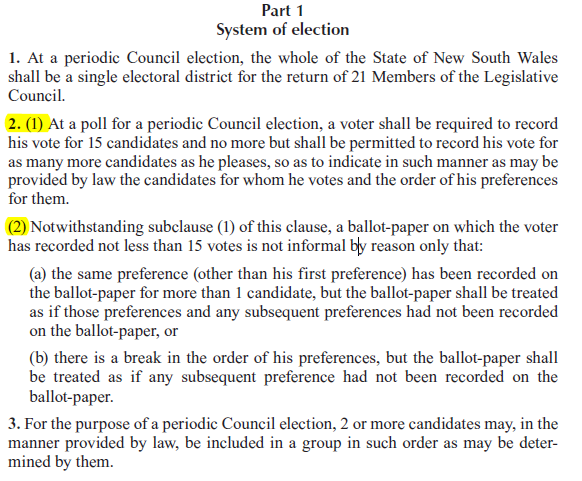
                         <enumerator>1.</enumerator> At a periodic Council election,
            the whole of the State of New South Wales shall be a single electoral district for the
            return of 21 Members of the Legislative Council.</p>
        </div3>
        <div3 doi="10.1093/law-ocw/law-ocw-cd927.023.0450" id="law-ocw-cd927-div3-450"><titleGroup id="law-ocw-cd927-titleGroup-133">
 <title id="law-ocw-cd927-title-133">
   <p id="law-ocw-cd927-p-834">
                                 <enumerator>2.</enumerator>
                             </p>
 </title></titleGroup><div4 doi="10.1093/law-ocw/law-ocw-cd927.024.0300" id="law-ocw-cd927-div4-300">
 <p>
                             <enumerator>(1)</enumerator> At a poll for a periodic Council election, a voter shall
              be required to record his vote for 15 candidates and no more but shall be permitted to
              record his vote for as many more candidates as he pleases, so as to indicate in such
              manner as may be provided by law the candidates for whom he votes and the order of his
              preferences for them.</p></div4><div4 doi="10.1093/law-ocw/law-ocw-cd927.024.0301" id="law-ocw-cd927-div4-301">
 <p>
                             <enumerator>(2)</enumerator> Notwithstanding subclause (1) of this clause, a
              ballot-paper on which the voter has recorded not less than 15 votes is not informal by
              reason only that:</p>
 <p>
                             <list class="other" id="law-ocw-cd927-list-89">
     <list1 id="law-ocw-cd927-list1-86" listType="structured">
       <item1 id="law-ocw-cd927-item1-243">
         <p id="law-ocw-cd927-p-836">
                                             <enumerator>(a)</enumerator> the same preference
                      (other than his first preference) has been recorded on the ballot-paper for
                      more than 1 candidate, but the ballot-paper shall be treated as if those
                      preferences and any subsequent preferences had not been recorded on the
                      ballot-paper, or</p>
       </item1>
       <item1 id="law-ocw-cd927-item1-244">
         <p id="law-ocw-cd927-p-837">
                                             <enumerator>(b)</enumerator> there is a break in the
                      order of his preferences, but the ballot-paper shall be treated as if any
                      subsequent preference had not been recorded on the ballot-paper.</p>
       </item1>
     </list1>
   </list>
                         </p></div4>
        </div3>
        <div3 doi="10.1093/law-ocw/law-ocw-cd927.023.0459" id="law-ocw-cd927-div3-459"><p id="law-ocw-cd927-p-838">
                         <enumerator>3.</enumerator> For the purpose of a periodic
            Council election, 2 or more candidates may, in the manner provided by law, be included
            in a group in such order as may be determined by them.</p>
        </div3>
      </div2>