Display graphics
Display graphics do not appear within a text node. They look like figures but do not have a caption, title or source. Capture a display graphic within a p element, on its own with no other content. Give the graphic element an attribute role="display".
//p/graphic[@role="display"]
If a cross-reference to a footnote or endnote appears inside or immediately after a display graphic, create a new p element immediately following the p element containing the graphic and capture the reference inside it.
Manuscript
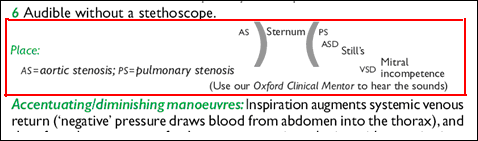
(red box highlights the graphic)
XML
      <div3 id="med-9780198530855-chapter-12-div3-159">
        <p><list>
 <list1 listType="structured">
   <!-- earlier items -->
   <item1 id="med-9780198530855-chapter-12-item1-0001">
     <p>
                                 <enumerator>6</enumerator> Audible without a stethoscope.</p>
   </item1>
 </list1></list>
        </p>
        <p><graphic sysId="med-9780198530855-graphic-013.tif" id="med-9780198530855-chapter-12-graphic-14" role="display"/>
        </p>
      </div3>
      <div3 id="med-9780198530855-chapter-12-div3-159">
        <titleGroup><title>
 <p>Accentuating/diminishing manoeuvres:</p></title>
        </titleGroup>
        <!-- content of div3 -->
      </div3>
XML for display graphic followed by note reference
      <p>Another poet who knew well how to exploit the robust rhythms of the dolnik was Robert
        Browning. The first set of poems in his first volume of short poems, the 1842 collection<i>Dramatic Lyrics</i>, is entitled ‘Cavalier Tunes’; the initial poem, ‘Marching Along’,
        begins:</p>
      <p>
             <graphic id="oxfordhb-9780199576463-e-002-graphic-8" role="display" sysId="oxfordhb-9780199576463-graphic-012.jpg"/>
         </p>
      <p>
             <xrefGrp role="endnote">
                 <xref ref="oxfordhb-9780199576463-e-002-note-20">
                     <su>20</su>
                 </xref>
             </xrefGrp>
         </p>
      <p>The first line—unsurprisingly, one of Browning’s most catchy openings—announces its
        rhythmic lineage immediately: ...</p>