Themed Features (chaptered works)
Themed features are elements in a title or series that have a particular theme or design which indicates a common meaning or function.
| FT1, FT2, FT3, FT4, FT5, etc. | Used for themed features. The number represents the particular feature theme |
| FT1a, FT1b, FT1c, , etc. | Used for sub-features within features. |
| FTY | Feature type, used for the supertitle of the themed feature |
| FET | Feature title, used for the title of the themed feature |
| FEN | Feature number |
| FSN | Feature source note |
//@role
Features are represented by the FT# typecode. Capture the FT# typecode as the value of the role attribute.
Common types of themed features include:
- Learning Objectives
- Learning Outcomes
- Chapter Overviews
- Reader's Guide
- Thinking Points
- Pause for reflection
- Stop & Think
- Reflection Point
- Food for thought
- Key Terms
- Key Points
- Case Studies
- Market Studies
- Mini Case
- Discussion Topic
- Commentary
- Answer Plan
- Suggested Answer
- Further Study
- Summary Points
- Conclusions
- Link to...
- Questions
- Self-test Questions
- Activities
- Practical Exercises
- Start/End of Chapter Summary
- Self-Assessment Questions
Feature can be represented by a variety of structures in a text. Some structures may include division (div[1-7,N]) elements, boxed matter (boxedMatter) elements, miscellaneous matter (miscMatter)elements, inline elements (span). This is not an exhaustive list. Mark content according to the structure present. When a feature typecode is present mark that structure with the role attribute.
When the same themed feature type is captured using more than one structure, all must stilll be identified with the same role attribute value as represented by the typecode number.
Capture Feature Types, represented by typecode FTY as a supertitle element within the titleGroup group. Do not capture inline graphics that may appear in feature titles or supertitles as these are a a matter of text design and not meaning, unless otherwise indicated by OUP to capture these.
Definitions are not features. Capture these as note elements with attribute role="definition".
Example boxed-matter with a feature type and feature title, case
close-up
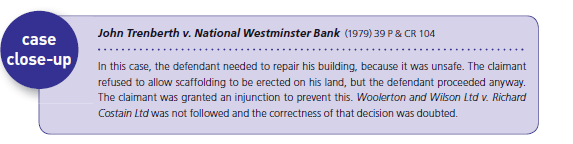
<boxedMatter role="FT1">
<titleGroup><supertitle>
<p>case close-up</p></supertitle><title>
<p>
<b>
<i>John Trenberth v. National Westminster Bank</i>
</b> (1979) 39 P & CR
104</p></title>
</titleGroup>
<textMatter><p>In this case, the defendant needed to repair his building, because it was unsafe. The
claimant refused to allow scaffolding to be erected on his land, but the defendant
proceeded anyway. The claimant was granted an injunction to prevent this. <i>Woolerton
and Wilson Ltd v. Richard Costain Ltd</i> was not followed and the correctness of that
decision was doubted.</p>
</textMatter>
</boxedMatter>
Example boxed matter with a feature type, but no feature title
Source document

XML
      <boxedMatter role="FT1">
        <titleGroup><supertitle>
 <p>example</p></supertitle>
        </titleGroup>
        <textMatter><p> Anna owns a house that is built on land above a coalfield. She owns the surface of the
            land (and the house built on it), but the land beneath the surface – that with the coal
            in it – may be owned by the British Mining Company.</p>
        </textMatter>
      </boxedMatter>
Example themed feature without a feature type but with a feature title
Source document
XML
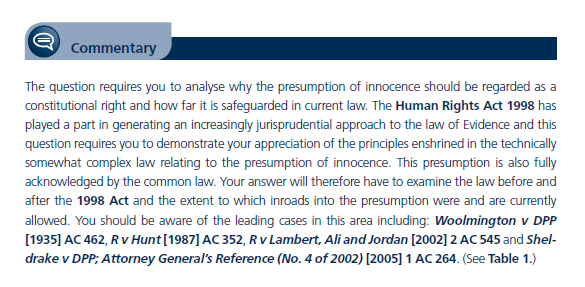
      <div1 id="he-9780199661954-div1-12" role="FT2" doi="10.1093/he/9780199661954.021.0012">
        <titleGroup id="he-9780199661954-titleGroup-22"><title>
 <p>Commentary</p></title>
        </titleGroup>
        <p fullOut="Y">The question requires you to analyse why the presumption of innocence should
          be regarded as a constitutional right and how far it is safeguarded in current law. The
 <span role="Key legislation">
                     <b>Human Rights Act 1998</b>
                 </span> has played a part in
          generating an increasingly jurisprudential approach to the law of Evidence and this
          question requires you to demonstrate your appreciation of the principles enshrined in the
          technically somewhat complex law relating to the presumption of innocence. This
          presumption is also fully acknowledged by the common law. Your answer will therefore have
          to examine the law before and after the <span role="Key legislation">
                     <b>1998
            Act</b>
                 </span> and the extent to which inroads into the presumption were and are
          currently allowed. You should be aware of the leading cases in this area including: <span role="Key cases">
                     <b>
                         <i>Woolmington v DPP</i> [1935] AC 462</b>
                 </span>, <span role="Key cases">
                     <b>
                         <i>R v Hunt</i> [1987] AC 352</b>
                 </span>, <span role="Key cases">
                     <b>
   <i>R v Lambert, Ali and Jordan</i> [2002] 2 AC 545</b>
                 </span> and <span role="Key cases">
                     <b>
   <i>Sheldrake v DPP; Attorney General's Reference (No. 4 of 2002)</i> [2005] 1 AC
              264</b>
                 </span>. (See <span role="Cross reference">
                     <xrefGrp>
                         <b>Table</b>
   <xref ref="he-9780199661954-tableGroup-1">
     <b>1</b>
                         </xref>
                     </xrefGrp>
                 </span>.)</p>
      </div1>
Example themed feature where icon should not be captured.
Source document

XML
      <div1 role="FT6">
        <titleGroup><title>
 <p>Conclusion</p></title>
        </titleGroup>
        <p>In the fourth edition of this book we suggested that the HRA 1998 was likely to have some
          impact on what we have previously called 'judicial style'. The shift from traditional
          permissive approach of civil liberties, characterised by the idea that we are free to</p>
      </div1>
Example themed feature for legal extract.
Source document
XML
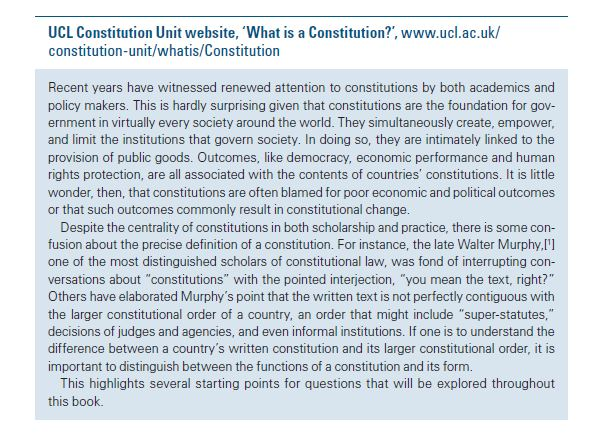
      <div5 doi="10.1093/he/9780198735380.003.0019.025.5004" id="he-9780198735380-chapter-19-div5-5004" role="FT6">
        <titleGroup id="he-9780198735380-chapter-19-titleGroup-6"><title id="he-9780198735380-chapter-19-title-6">
 <p id="he-9780198735380-chapter-19-p-13">
                         <b>UCL Constitution Unit website, ‘What is a
                Constitution?’,</b>
   <url id="he-9780198735380-chapter-19-url-1" webUrl="http://www.ucl.ac.uk/constitution-unit/whatis/Constitution">www.ucl.ac.uk/constitution-unit/whatis/Constitution</url>
                     </p></title>
        </titleGroup>
        <p>
                 <extract class="forDom" confirmation="requested" id="he-9780198735380-chapter-19-extract-1" linkType="mentioned">
 <textMatter id="he-9780198735380-chapter-19-textMatter-1">
   <div1 doi="10.1093/he/9780198735380.003.0019.021.5686" id="he-9780198735380-chapter-19-div1-5686">
     <p fullOut="Y" id="he-9780198735380-chapter-19-p-14">Recent years have witnessed
                  renewed attention to constitutions by both academics and policy makers. This is
                  hardly . . . </p>
   </div1>
 </textMatter></extract>
             </p>
      </div5>