Latin-based languages in headings
In frontlist content, where the typecode LANG:ISO is used, capture foreign languages in headings using a span element with attribute xml:lang set with a value of the ISO 639 three digit code for languages.
|
LAN:XXX |
Typecode to identify non-English text. The typecode LAN is followed by a suffix representing the three digit letter ISO 639-2 language code, i.e. LAN:LAT indicates a latin word, or LAN:FRE indicates a french word. |
Only capture this information in frontlist content where the typecode LAN:XXX is used.
When the typecode LAN:XXX is used, mark up the foreign language using a span element with attribute xml:lang. The value of the xml:lang attribute must be set to the three digit code for languages as given in the standard ISO 639. This code will also form the suffix of the typecode. Also include an italic tag, i within the span and around content.
Only capture this information in the instance of headings (i.e. within titleGroup).
In some instances a foreign language may make up an entire title. In this case it is appropriate to have the entire heading marked up using the span and i element in conjunction.
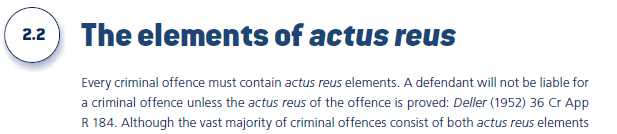
      <div1>
        <titleGroup><title>
 <p>
                         <enumerator>2.2</enumerator> The elements of <span xml:lang="lat">
                             <i>actus
                reus</i>
                         </span>
                     </p></title>
        </titleGroup>
        <p>Every criminal offence must contain <i>actus reus</i> elements. A defendant will not be
          liable for a criminal offence unless the <i>actus reus</i> of the offence is proved:
 <i>Deller</i> (1952) 36 Cr App R 184. Although the vast majority of criminal offences
          consist of both <i>actus reus</i> elements...</p>
      </div1>