Example EMQ Question and Answers
Example XML for Extended Matching Questions (EMQs) section.
For clarity, only the id attributes necessary for linking together questions with their answers are included. Other required attributes (e.g. listType) are omitted. Questions and answers are shown in the same section, but that is not always the case.
EMQ: Answer Explanation as one chunk

      <div1>
        <titleGroup><title>
 <p>Questions and Answers</p></title>
        </titleGroup>
        <div2 role="Q"><titleGroup>
 <title>
   <p>Questions</p>
 </title></titleGroup><div3 role="EMQ-question">
 <titleGroup>
   <title>
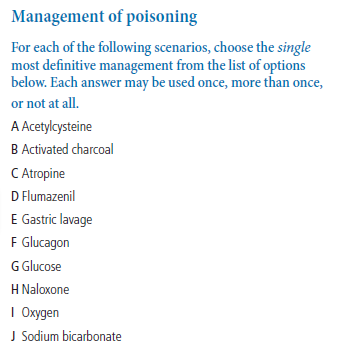
     <p>Management of Poisoning</p>
   </title>
 </titleGroup>
 <p role="instruction">For each of the following scenarios, choose the <i>single</i> most
              definitive management from the list of options below. Each answer may be used once,
              more than once, or not at all.:</p>
 <p>
   <list>
     <list1>
       <item1 role="option" id="prod-9780191234567-chapter-2-item1-9991">
         <p>
                                         <enumerator>A</enumerator> Acetylcysteine</p>
       </item1>
       <item1 role="option" id="prod-9780191234567-chapter-2-item1-9992">
         <p>
                                         <enumerator>B</enumerator> Activated charcoal</p>
       </item1>
       <item1 role="option" id="prod-9780191234567-chapter-2-item1-9993">
         <p>
                                         <enumerator>C</enumerator> Atropine</p>
       </item1>
       <item1 role="option" id="prod-9780191234567-chapter-2-item1-9994">
         <p>
                                         <enumerator>D</enumerator> Flumazenil</p>
       </item1>
       <item1 role="option" id="prod-9780191234567-chapter-2-item1-9995">
         <p>
                                         <enumerator>E</enumerator> Gastric lavage</p>
       </item1>
       <item1 role="option" id="prod-9780191234567-chapter-2-item1-9996">
         <p>
                                         <enumerator>F</enumerator> Glucagon</p>
       </item1>
       <item1 role="option" id="prod-9780191234567-chapter-2-item1-9997">
         <p>
                                         <enumerator>G</enumerator> Glucose</p>
       </item1>
       <item1 role="option" id="prod-9780191234567-chapter-2-item1-9998">
         <p>
                                         <enumerator>H</enumerator> Naloxone</p>
       </item1>
       <item1 role="option" id="prod-9780191234567-chapter-2-item1-9999">
         <p>
                                         <enumerator>G</enumerator> Oxygen</p>
       </item1>
       <item1 role="option" id="prod-9780191234567-chapter-2-item1-10000">
         <p>
                                         <enumerator>H</enumerator> Sodium bicarbonate</p>
       </item1>
     </list1>
   </list>
 </p>
 <p>
   <list>
     <list1>
       <item1 role="scenario" id="prod-9780191234567-chapter-2-item1-10001">
         <p>
                                         <enumerator>3.</enumerator> A 32-year-old woman has taken an unknown number
                      of amitriptyline tablets. She is opening her eyes on vocal command,
                      withdrawing on painful stimulus, and is making incomprehensible sounds. The
                      ECG shows a heart rate of 122bpm, PR interval 0.28s, and QRS 0.2s. The ph is
                      6.9, pO<sub>2</sub> 28kPa on 40% oxygen, PCO<sub>2</sub> 4.0kPa, bicarbonate
                      19mmol/L and base excess -6.</p>
       </item1>
       <item1 role="scenario" id="prod-9780191234567-chapter-2-item1-10002">
         <p>
                                         <enumerator>4.</enumerator> A 76-year-old man has taken 30 atenolol tablets,
                      one of his regular medications. He is feeling unwell and his heart rate is 54
                      bpm and BP 110/70 mmHg.</p>
       </item1>
       <!-- Other scenarios, in more item1 elements, would go here -->
     </list1>
   </list>
 </p></div3><!-- Other questions, in more div3 elements, and with different options and scenarios, under a different heading, would go here. -->
        </div2>
        <div2 role="A"><titleGroup>
 <title>
   <p>Answers</p>
 </title></titleGroup><div3 role="EMQ-answer">
 <titleGroup>
   <title>
     <p>Management of Poisoning</p>
   </title>
 </titleGroup>
 <p>
   <list>
     <list1>
       <item1 id="med-9780199694389-chapter-1-item1-1">
         <p>
                                         <enumerator>3.</enumerator>
           <xrefGrp role="answer">
                                             <xref ref="prod-9780191234567-chapter-2-item1-10001"/>
                                             <xref ref="prod-9780191234567-chapter-2-item1-9992">
                                                 <b>J</b>
                                             </xref>
                                         </xrefGrp>★<span role="further-reading">OHEM, 4th edn
                        → 196</span> The symptoms of representative of tricyclic
                      antidepressant poisoning. The patients GCS score is 9/15 and she has ECG
                      changes. She is also acidotic (metabolic acidosis). An IV bolus dose of
                      50-100mL of 8.4% sodium bicarbonate may result in dramatic improvement in the
                      patient's condition. Sodium bicarbonate alters the protein-binding site and
                      reduces the availability of active free tricyclic drug. → <url webUrl="www.toxbase.org/Poisons-Index-A-Z/A-Products/Amitriptyline">www.toxbase.org/Poisons-Index-A-Z/A-Products/Amitriptyline</url>
                                     </p>
       </item1>
       <item1 id="med-9780199694389-chapter-1-item1-2">
         <p>
                                         <enumerator>4.</enumerator>
           <xrefGrp role="answer">
                                             <xref ref="prod-9780191234567-chapter-2-item1-10002"/>
                                             <xref ref="prod-9780191234567-chapter-2-item1-9994">
                                                 <b>F</b>
                                             </xref>
                                         </xrefGrp>★ <span role="further-reading">OHEM, 4th edn
                        → 200</span> The cardio selectivity of atenolol is lost in overdoses.
                      At the β-receptor level, β-blockers competitively inhibit
                      catecholomines (adrenaline (epinephrine)). Catacholomines increase myocardial
                      contraction (inotropic effect), incresae the heart rate (chronotropic effect)
                      and increase cardiac conduction. β-blockers are rapidly absorbed from
                      the GI-tract, reaching peak plasma levels within one to 4h. Most common toxic
                      features are bradycardia followed by hypotension and unconsciousness.
                      Immediate management is oxygen, IV fluids and cardiac monitoring. Activated
                      charcoal may be given within the first hour of ingestion but its benefit is
                      not proven. The initial treatment is atropine 0.5mg IV. It may be ineffective
                      in reversing bradycardia and hypotension. The next and the best treatment is
                      glucagon (2-10mg IV), which does not depend on β-receptors for its
                      actions. It has both inotropic and chronotropic actions based on its
                      activation of the myocardial adenylatecyclase system, producing dramatic
                      improvment in pulse, BP, and return of consciousness. → <url webUrl="www.toxbase.org/Poisons-Index-A-Z/A-Products/Amitriptyline">www.toxbase.org/Poisons-Index-A-Z/A-Products/Atenolol</url>
                                     </p>
       </item1>
       <!-- The answers to other scenarios, in more item1 elements, would go here -->
     </list1>
   </list>
 </p></div3><!-- The answers to other questions, in more div3 elements, would go here -->
        </div2>
      </div1>
EMQ: Answer Explanation split into separate lines


      <div1>
        <titleGroup><title>
 <p>Questions and Answers</p></title>
        </titleGroup>
        <div2 doi="10.1093/med/9780198745594.003.0001.022.0002" id="med-9780198745594-chapter-1-div2-2" role="Q"><titleGroup id="med-9780198745594-chapter-1-titleGroup-100">
 <title>
   <p><?Page pageId="13"?>Extended Matching Questions</p>
 </title></titleGroup><div3 doi="10.1093/med/9780198745594.003.0001.023.0051" id="med-9780198745594-chapter-1-div3-51" role="EMQ-question">
 <titleGroup id="med-9780198745594-chapter-1-titleGroup-5">
   <title>
     <p>Options for questions 1–5</p>
   </title>
 </titleGroup>
 <p role="instruction">For each of the following clinical scenarios, choose the single
              diagnosis most appropriate treatment. Each option may be used once, more than once, or
              not at all.</p>
 <p>
                         <list class="other">
     <list1 listType="structured">
       <item1 role="option" id="med-9780198745594-chapter-1-item1-251">
         <p>
                                         <enumerator>A.</enumerator> Cerebral vascular thrombosis</p>
       </item1>
       <item1 role="option" id="med-9780198745594-chapter-1-item1-252">
         <p>
                                         <enumerator>B.</enumerator> Cluster headache</p>
       </item1>
       <item1 role="option" id="med-9780198745594-chapter-1-item1-253">
         <p>
                                         <enumerator>C.</enumerator> Conjunctivitis</p>
       </item1>
       <item1 role="option" id="med-9780198745594-chapter-1-item1-254">
         <p>
                                         <enumerator>D.</enumerator> Epilepsy</p>
       </item1>
       <item1 role="option" id="med-9780198745594-chapter-1-item1-255">
         <p>
                                         <enumerator>E.</enumerator> Impending eclampsia</p>
       </item1>
       <item1 role="option" id="med-9780198745594-chapter-1-item1-256">
         <p>
                                         <enumerator>F.</enumerator> Intracranial haemorrhage</p>
       </item1>
       <item1 role="option" id="med-9780198745594-chapter-1-item1-257">
         <p>
                                         <enumerator>G.</enumerator> Malaria</p>
       </item1>
       <item1 role="option" id="med-9780198745594-chapter-1-item1-258">
         <p>
                                         <enumerator>H.</enumerator> Meningitis</p>
       </item1>
       <item1 role="option" id="med-9780198745594-chapter-1-item1-259">
         <p>
                                         <enumerator>I.</enumerator> Migraine</p>
       </item1>
       <item1 role="option" id="med-9780198745594-chapter-1-item1-260">
         <p>
                                         <enumerator>J.</enumerator> Severe pre-eclampsia</p>
       </item1>
       <item1 role="option" id="med-9780198745594-chapter-1-item1-261">
         <p>
                                         <enumerator>K.</enumerator> Sinusitis</p>
       </item1>
       <item1 role="option" id="med-9780198745594-chapter-1-item1-262">
         <p>
                                         <enumerator>L.</enumerator> Subarachnoid haemorrhage</p>
       </item1>
       <item1 role="option" id="med-9780198745594-chapter-1-item1-263">
         <p>
                                         <enumerator>M.</enumerator> Viral gastritis</p>
       </item1>
     </list1>
   </list>
                     </p>
 <p>
                         <list class="other">
     <list1 listType="structured">
       <item1 id="med-9780198745594-chapter-1-item1-747" role="scenario">
         <p>
                                         <enumerator>1.</enumerator> A 27-year-old primigravid woman at 24 weeks of
                      pregnancy is complaining of throbbing pain behind her left eye. This pain is
                      so severe that she cannot sit still.</p>
       </item1>
       <item1 id="med-9780198745594-chapter-1-item1-748" role="scenario">
         <p>
                                         <enumerator>2.</enumerator> An 18-year-old primigravid woman at 36 weeks of
                      pregnancy is complaining of sudden onset of headaches, abdominal pain, and a
                      sensation of flashing lights in front of her eyes.</p>
       </item1>
       <item1 id="med-9780198745594-chapter-1-item1-749" role="scenario">
         <p>
                                         <enumerator>3.</enumerator> A 24-year-old multiparous woman at 30 weeks of
                      pregnancy has returned from her holidays in Brazil. She is vomiting, feeling
                      feverish, and complaining of severe headaches.</p>
       </item1>
       <item1 id="med-9780198745594-chapter-1-item1-750" role="scenario">
         <p>
                                         <enumerator>4.</enumerator> A 35-year-old parous woman at 20 weeks of
                      pregnancy complains of severe headaches and feeling tired, feverish, and stiff
                      around her neck.</p>
       </item1>
       <item1 id="med-9780198745594-chapter-1-item1-751" role="scenario">
         <p>
                                         <enumerator>5.</enumerator> A recently delivered multiparous woman with a BMI
                      of 45 complains on day three post-partum of sudden onset of severe headache,
                      describing it as the ‘worst headache I ever had’.</p>
       </item1>
     </list1>
   </list>
                     </p></div3><!-- other questions, in more div3 elements would go here -->
        </div2>
        <div2 doi="10.1093/med/9780198745594.003.0001.022.0004" id="med-9780198745594-chapter-1-div2-4" role="A"><titleGroup id="med-9780198745594-chapter-1-titleGroup-17">
 <title>
   <p><?Page pageId="32"?>Extended Matching Questions</p>
 </title></titleGroup><div3 doi="10.1093/med/9780198745594.003.0001.023.0111" id="med-9780198745594-chapter-1-div3-111" role="EMQ-answer">
 <titleGroup id="med-9780198745594-chapter-1-titleGroup-28">
   <title>
     <p>Answers for questions 1–5</p>
   </title>
 </titleGroup>
 <p>
                         <xrefGrp role="answer">
                             <xref ref="med-9780198745594-chapter-1-item1-747">
                                 <b>1.</b>
                             </xref>
                             <xref ref="med-9780198745594-chapter-1-item1-252">
                                 <b>B</b>
                             </xref>
                         </xrefGrp>; <xrefGrp role="answer">
                             <xref ref="med-9780198745594-chapter-1-item1-748">
                                 <b>2.</b>
                             </xref>
                             <xref ref="med-9780198745594-chapter-1-item1-255">
                                 <b>E</b>
                             </xref>
                         </xrefGrp>; <xrefGrp role="answer">
                             <xref ref="med-9780198745594-chapter-1-item1-749">
                                 <b>3.</b>
                             </xref>
                             <xref ref="med-9780198745594-chapter-1-item1-257">
                                 <b>G</b>
                             </xref>
                         </xrefGrp>; <xrefGrp role="answer">
                             <xref ref="med-9780198745594-chapter-1-item1-750">
                                 <b>4.</b>
                             </xref>
                             <xref ref="med-9780198745594-chapter-1-item1-258">
                                 <b>H</b>
                             </xref>
                         </xrefGrp>; <xrefGrp role="answer">
                             <xref ref="med-9780198745594-chapter-1-item1-751">
                                 <b>5.</b>
                             </xref>
                             <xref ref="med-9780198745594-chapter-1-item1-251">
                                 <b>A</b>
                             </xref>
                         </xrefGrp>
                     </p>
 <p role="explanation">
                         <xrefGrp>
                             <xref ref="med-9780198745594-chapter-1-item1-747">1.</xref>
                         </xrefGrp> Cluster headaches are uncommon and affect men more often than
              women. The word ‘cluster’ is used as the sufferers get a number of
              attacks over a few weeks and thereafter they are symptom-free for months or years.
              Cluster headaches normally present with severe headache which is much worse than
              migraine. The pain usually occurs at the same time each day and quite often wakens the
              individual a few hours after they have gone to sleep. Migraine is usually categorized
              according to whether or not there is aura.</p>
 <p role="explanation">
                         <xrefGrp>
                             <xref ref="med-9780198745594-chapter-1-item1-748">2.</xref>
                         </xrefGrp> Impending eclampsia, as this patient has risk factors such as
              being primigravida, under 20, and has sudden onset of headache and flashing lights.
              Her abdominal pain may be suggestive of perihepatic capsular congestion.</p>
 <p role="explanation">
                         <xrefGrp>
                             <xref ref="med-9780198745594-chapter-1-item1-748">3.</xref>
                         </xrefGrp> A history of travel is reported; therefore the most likely
              diagnosis is cerebral malaria, which is suggestive of severe headache and
              vomiting.</p>
 <p role="explanation">
                         <xrefGrp>
                             <xref ref="med-9780198745594-chapter-1-item1-748">4.</xref>
                         </xrefGrp> Meningitis is highly likely; the only giveaway would be that
              petechial rash has not been mentioned, which could be suggestive of meningococcal
              infection.</p>
 <p role="explanation">
                         <xrefGrp>
                             <xref ref="med-9780198745594-chapter-1-item1-748">5.</xref>
                         </xrefGrp> Cerebrovascular thrombosis usually occurs post-partum and has
              been noted even in the first trimester in the confidential enquiries into maternal
              deaths. Patients usually describe it as ‘the worst I ever had’ headache.
              In the presence of leucocytosis, differential diagnosis will include puerperal
              sepsis.</p>
 <p role="further-reading">Centre for Maternal and Child Enquiries. Saving
              mothers’ lives: reviewing maternal deaths to make motherhood safer:
              2006–08. <bibItem id="med-9780198745594-chapter-1-bibItem-388" class="journalArticle" title="The eighth report on Confidential Enquiries into Maternal Deaths in the United Kingdom" journalName="BJOG" date="2011" vol="118" journalIssue="1" page="1" pageLast="203">The eighth report on Confidential Enquiries into Maternal Deaths in the United
                Kingdom. BJOG. 2011;118(Suppl. 1):1–203</bibItem>.</p></div3><!-- other answers, in more div3 elements would go here -->
        </div2>
      </div1>
EMQ Question where a graphic represents the answer options

      <div3 doi="10.1093/med/9780199862153.003.0001.023.0005" id="med-9780199862153-chapter-1-div3-5" role="EMQ-question">
        <p role="instruction">Match the letters on the anatomic structure shown in the figure with
          the appropriate label listed below.</p>
        <p role="instruction">
                 <graphic id="med-9780199862153-chapter-1-graphic-83" role="display" sysId="med-9780199862153-chapter-1-graphic-081.gif"/>
             </p>
        <p display="online">
                 <list>
 <list1 listType="structured">
   <item1 role="option" id="med-9780199862153-chapter-1-item1-1010">
     <p>
                                 <enumerator>A</enumerator>
                             </p>
   </item1>
   <item1 role="option" id="med-9780199862153-chapter-1-item1-1011">
     <p>
                                 <enumerator>B</enumerator>
                             </p>
   </item1>
   <item1 role="option" id="med-9780199862153-chapter-1-item1-1012">
     <p>
                                 <enumerator>C</enumerator>
                             </p>
   </item1>
   <item1 role="option" id="med-9780199862153-chapter-1-item1-1013">
     <p>
                                 <enumerator>D</enumerator>
                             </p>
   </item1>
   <item1 role="option" id="med-9780199862153-chapter-1-item1-1014">
     <p>
                                 <enumerator>E</enumerator>
                             </p>
   </item1>
   <item1 role="option" id="med-9780199862153-chapter-1-item1-1015">
     <p>
                                 <enumerator>F</enumerator>
                             </p>
   </item1>
 </list1></list>
             </p>
        <p continued="N" fullOut="N" runin="N"><list>
 <list1 listType="structured">
   <item1 role="scenario" id="med-9780199862153-chapter-1-item1-1016">
     <p>
                                 <enumerator>1.8</enumerator> ______ Vallecula</p>
   </item1>
   <item1 role="scenario" id="med-9780199862153-chapter-1-item1-1017">
     <p>
                                 <enumerator>1.9</enumerator> ______ Region of the vocal cords</p>
   </item1>
   <item1 role="scenario" id="med-9780199862153-chapter-1-item1-1018">
     <p>
                                 <enumerator>1.10</enumerator> ______ Pyriform sinus</p>
   </item1>
 </list1></list>
        </p>
      </div3>