Explanations for multiple answers
A single explanation can be given for multiple answers. Capture explanations that are given for several answers in a paragraph p element with role="multiple-explanation".
Inside the p element, insert an xrefGrp group with role="multiple-explanation" that spans the text of the multiple answer explanation. Inside the xrefGrp group insert an xref element for each answer to which the multiple answer explanation applies. Make the values of the ref attributes the same as the values of the id attributes of the question options the answers corresponds to.
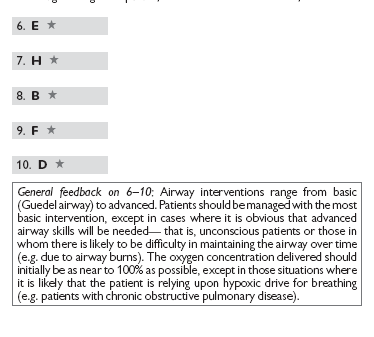
Explanations of multiple paragraphs are often shown in a box and start with "General feedback
on xx-yy", where "xx-yy" represents a range of answers. Capture these as a p
role="multiple-explanation".
Example of multiple explanations
XML
      <div3 id="med-9780199657582-chapter-2-div3-1246" role="EMQ-answer">
        <p>
                 <enumerator>6.</enumerator><xrefGrp role="answer">
                     <xref ref="med-9780199657582-chapter-2-p-235"/>
                     <xref id="med-9780199657582-chapter-2-xref-590" ref="med-9780199657582-chapter-2-item1-2540">
                         <b>E</b>
                     </xref>
                 </xrefGrp>★ </p>
      </div3>
      <div3 id="med-9780199657582-chapter-2-div3-1247" role="EMQ-answer">
        <p>
                 <enumerator>7.</enumerator><xrefGrp role="answer">
                     <xref ref="med-9780199657582-chapter-2-p-236"/>
                     <xref id="med-9780199657582-chapter-2-xref-591" ref="med-9780199657582-chapter-2-item1-2543">
                         <b>H</b>
                     </xref>
                 </xrefGrp>★ </p>
      </div3>
      <div3 id="med-9780199657582-chapter-2-div3-1248" role="EMQ-answer">
        <p>
                 <enumerator>8.</enumerator><xrefGrp role="answer">
                     <xref ref="med-9780199657582-chapter-2-p-237"/>
                     <xref id="med-9780199657582-chapter-2-xref-592" ref="med-9780199657582-chapter-2-item1-2537">
                         <b>B</b>
                     </xref>
                 </xrefGrp>★ </p>
      </div3>
      <div3 id="med-9780199657582-chapter-2-div3-1249" role="EMQ-answer">
        <p>
                 <enumerator>9.</enumerator><xrefGrp role="answer">
                     <xref ref="med-9780199657582-chapter-2-p-238"/>
                     <xref id="med-9780199657582-chapter-2-xref-593" ref="med-9780199657582-chapter-2-item1-2541">
                         <b>F</b>
                     </xref>
                 </xrefGrp>★ </p>
      </div3>
      <div3 id="med-9780199657582-chapter-2-div3-1250" role="EMQ-answer">
        <p>
                 <enumerator>10.</enumerator><xrefGrp role="answer">
                     <xref ref="med-9780199657582-chapter-2-p-239"/>
                     <xref id="med-9780199657582-chapter-2-xref-594" ref="med-9780199657582-chapter-2-item1-2539">
                         <b>D</b>
                     </xref>
                 </xrefGrp>★ </p>
        <p role="multiple-explanation"><xrefGrp role="multiple-explanation">
 <xref ref="med-9780199657582-chapter-2-div3-1246"/>
 <xref ref="med-9780199657582-chapter-2-div3-1247"/>
 <xref ref="med-9780199657582-chapter-2-div3-1248"/>
 <xref ref="med-9780199657582-chapter-2-div3-1249"/>     <xref ref="med-9780199657582-chapter-2-div3-1250"/>     General feedback on 6–10:</xrefGrp>Airway interventions range from basic (Guedel airway) to advanced. Patients
          should be managed with the most basic intervention, except in cases where it is obvious
          that advanced airway skills will be needed—that is, unconscious patients or those in whom
          there is likely to be difficulty in maintaining the airway over time (e.g. due to airway
          burns). The oxygen concentration delivered should initially be as near to 100% as
          possible, except in those situations where it is likely that the patient is relying upon
          hypoxic drive for breathing (e.g. patients with chronic obstructive pulmonary
          disease).</p>
      </div3>