Example: Emphasis on paragraph with heading
Where a section of text is emphasized, and contains a heading that is not within the division hierarchy structure, capture the content as single p that contains displayText, and mark the heading as the title of the displayText. Mark the emphasis on the p that contains the displayText. Start a new paragraph for any content that comes after the emphasized portion.
Printed book

      <div3 id="med-9780199234219-chapter-1div3-17009" role="prelim" doi="10.1093/med/9780199234219.003.0001.023.3010">
        <p role="emphasis"><displayText class="other">
 <titleGroup>
   <title>
     <p>The Utility Equation</p>
   </title>
 </titleGroup>
 <p>Utility = Reliability × Validity × Feasibility × Acceptability × Educational
                  Impact<xrefGrp>
                             <xref ref="med-9780199234219-bibItem-008040">
                                 <sup>40</sup>
                             </xref>
                         </xrefGrp>
                     </p>
 <p>Apply the ‘Utility equation’ to determine which tests to use and when.</p></displayText>
        </p>
      </div3>
Printed book
XML
      <div1 id="med-9780199227242-chapter-3-div1-33">
        <titleGroup><title>
 <p><?Page pageId="52"?>
                         <milestone id="med-9780199227242-chapter-3-milestone-52" unit="page" num="52"/>Antepartum haemorrhage: overview</p></title>
        </titleGroup>
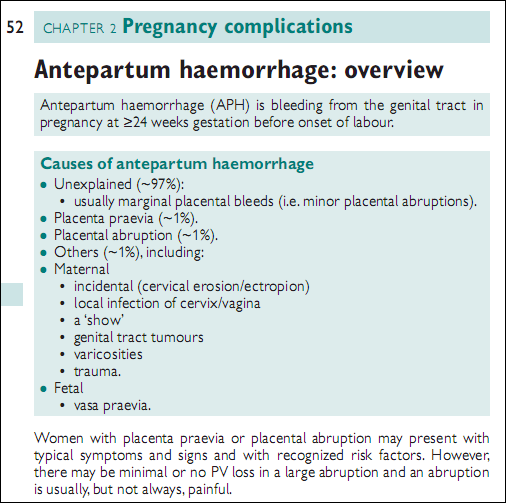
        <p role="emphasis">Antepartum haemorrhage (APH) is bleeding from the genital tract in
          pregnancy at ?24 weeks gestation before onset of labour.</p>
        <p role="emphasis"><displayText class="other">
 <titleGroup>
   <title>
     <p>Causes of antepartum haemorrhage</p>
   </title>
 </titleGroup>
 <p>
                         <list class="other">
     <list1 id="med-9780199227242-chapter-3-list1-1115" listType="unstructured">
       <item1 id="med-9780199227242-chapter-3-item1-4544">
         <p>
                                         <enumerator>•</enumerator> Unexplained (∼97%):</p>
         <list2 id="med-9780199227242-chapter-3-list2-478" listType="unstructured">
           <item2 id="med-9780199227242-chapter-3-item2-1167">
             <p>
                                                 <enumerator>•</enumerator> usually marginal placental bleeds (i.e.
                          minor placental abruptions).</p>
           </item2>
         </list2>
       </item1>
       <!-- content skipped for brevity -->
       <item1 id="med-9780199227242-chapter-3-item1-4549">
         <p>
                                         <enumerator>•</enumerator> Fetal</p>
         <list2 id="med-9780199227242-chapter-3-list2-480" listType="unstructured">
           <item2 id="med-9780199227242-chapter-3-item2-1174">
             <p>
                                                 <enumerator>•</enumerator> vasa praevia.</p>
           </item2>
         </list2>
       </item1>
     </list1>
   </list>
                     </p></displayText>
        </p>
        <p>Women with placenta praevia or placental abruption may present with typical symptoms and
          signs and with recognized risk factors. However, there may be minimal or no PV loss in a
          large abruption and an abruption is usually, but not always, painful.</p>
      </div1>