Readings (chaptered works)
Readings are long excerpts of previously published material that can contain Themed Features and extracts and are distinct from author written text. Mark readings using a role attribute on the divN set to 'RD#', where the # represents the number of the reading in that text.
| RD1, RD2, RD3, etc | Used for Readings. The number represents the distinct reading within a text. |
| RPL | Reading permission line |
| RN | Reading number |
| RT | Reading title |
| RST | Reading subtitle |
| RI | Reading intro |
| RA | Reading author |
Readings are long sets of previously published content that are interspersed among author written text. They can contain both extracts and features. Readings must be captured according to the divN structure of the book as a whole (as detailed by TCI topic Sections of text - div[1-7,N]). Readings will be marked in a manuscript with a typecode of 'RD#', where the number represents a distinct reading within a book. Mark up reading divisions denoted by this typecode with a role attribute set to the same value as the typecode.
Mark the Reading number and Reading name together as the enumerator and title within the titleGroup of the divN role="RD#". Mark the author of the reading if present in creatorInfo within the titleGroup of the divN role="RD#" as well. Mark the introductory paragraph (any content prior to the first heading level within the reading) as a divN role="prelim" within the reading (in according with Sections of text - div[1-7,N]) for regular divisions).
Readings often contain a reading permission line which will indicate bibliographic information about the reading. Capture this permission line in a bibItem element that is a descendant of a note element.
Example of a Reading
Source document
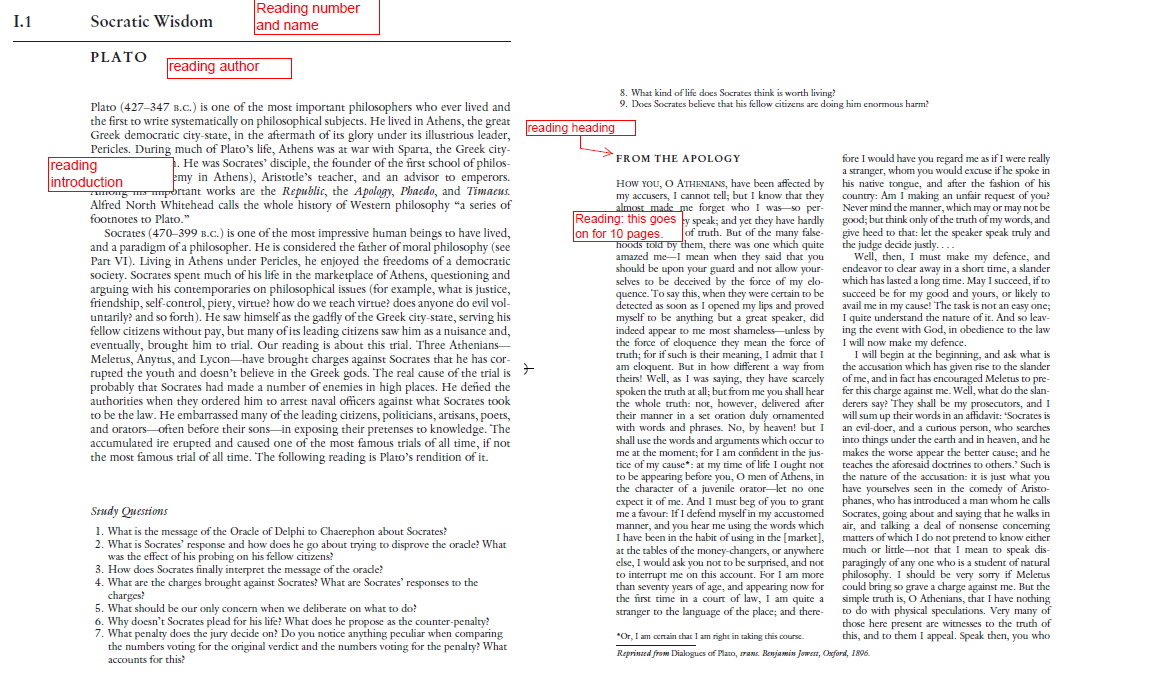
XML
      <div1 id="he-978019912345-chapter-1-div1-1" role="RD1">
        <titleGroup><title>
 <p>
                         <enumerator>I.1</enumerator> Socratic Wisdom</p></title><creatorInfo>
 <p>Plato</p></creatorInfo>
        </titleGroup>
        <div2 id="he-978019912345-chapter-1-div2-1" role="prelim"><p>Plato (427 - 347 B.C.) is one of the most imporatant philosophers who ever lived and
            the first to write systematically on philosophical subjects...</p><!-- additional paragraphs --><p>
                     <list>
   <title>
     <p>Study Questions</p>
   </title>
   <list1>
     <item1 id="he-978019912345-chapter-1-item1-1">
       <p>
                                     <enumerator>1.</enumerator> What is the message of the Oracle of Delphi to
                    Chaerephon about Socrates?</p>
     </item1>
   </list1>
 </list>
                 </p><!-- additional study questions -->
        </div2>
        <div2 id="he-978019912345-chapter-1-div2-2"><titleGroup>
 <title>
   <p>From the Apology</p>
 </title></titleGroup><p>How You, O Athenians, have been affected by my accusers, I cannot tell; but I know that
            they almost made me forget who I was...</p><!-- additional paragraphs or divisions of the reading -->
        </div2>
      </div1>
Example of a Reading Permission Line
Source document

XML
      <note type="footnote">
        <p>Reprinted from <bibItem class="book" title="Dialogues of Plato" translator="Benjamin Jowett" date="1986" place="Oxford">Dialogues of Plato, trans.
            Benjamin Jowett, Oxford, 1986.</bibItem>
             </p>
      </note>