What to capture from a decision
Capture the entire text of the decision including the names of the arbitrators or judges giving the decision. Do not capture preliminary text.
Some decision files have preliminary text at the start of the document, before the decision text. Do not capture the preliminary text because details such as the case name and party names, details of the court, decision date, citations already form part of the headnote.
Do not capture the signatures of arbitrators and judges.
Do not capture headers and footers, for example page numbers, the name of the body which released the text, etc.
You do not need to capture legal citations (bibItems) in judgments.
Capture decision text within the narrative structure of the OxLawRepML DTD. The textMatter element provides a nested structure that you can use to capture all the text. Before capture, analyse each decision and assess the relevant structural levels. Use heading levels to maintain the original structure for the online version.
Capture the version information in the versionInfo element.
Example
Input File
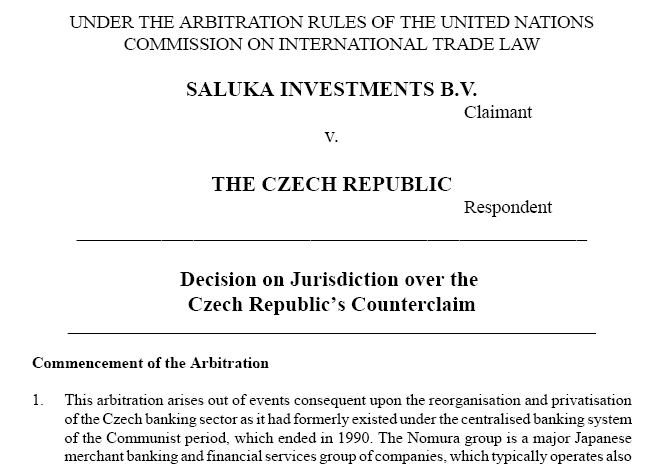
Captured XML
      <judgmentGrp>
        <judgment type="orig" xml:lang="eng"><textMatter>
 <div1 id="law-iic-1-2004-div1-23">
   <div2 id="law-iic-1-2004-div2-2">
     <titleGroup>
       <title>
         <p>Commencement of the Arbitration</p>
       </title>
     </titleGroup>
     <p>
                                 <enumerator>1</enumerator>This arbitration arises out of events...</p>
   </div2>
   <!-- ... -->
 </div1></textMatter>
        </judgment>
      </judgmentGrp>