Example legal extracts
Example uses of extracts from legal documents.
Example 1 (extract from legal material)
      <div6 id="law-ildc-186ca02-div6-106">
        <p id="law-ildc-186ca02-p-196"> ... the <bibItem id="law-ildc-186ca02-bibItem-251" class="intinstr" subClass="conv" title="International Convention for the Suppression of Terrorist Bombings">
 <i>International Convention for the Suppression of Terrorist Bombings</i>, 37 I.L.M.
            249</bibItem>. Second, the Convention supplements this offence–based list with a
          stipulative definition of terrorism. Article 2(1)(<i>b</i>) defines terrorism as:</p>
        <p>
             <extract id="law-ildc-186ca02-extract-4" class="intinstr" subClass="conv" title="International Convention for the Suppression of Terrorist Bombings" sectRef="Article 2(1)(b)">
 <textMatter>
   <p id="law-ildc-186ca02-p-197">Any ... act intended to cause death or serious bodily
                injury to a civilian, or to any other person not taking an active part in the
                hostilities in a situation of armed conflict, when the purpose of such act, by its
                nature or context, is to intimidate a population, or to compel a government or an
                international organization to do or to abstain from doing any act.</p>
 </textMatter></extract>
        </p>
      </div6>
Example 2 Manuscript (Extract with commentary)

Example 2 XML (Extract with commentary)
      <div2 id="he-9780199228270-chapter-1-div2-1">
        <titleGroup><title>
 <p>
                     <enumerator>11.5.1</enumerator> Article 5(2)</p></title>
        </titleGroup>
        <p><extract id="he-9780199228270-chapter-1-extract-4" class="intinstr" subClass="conv" title="European Convention on Human Rights" sectRef="Art.5(2)">
 <textMatter>
   <p>Everyone who is arrested shall be informed promptly, in a language which he
                understands, of the reasons for his arrest and of any charge against him</p>
 </textMatter></extract>
        </p>
        <p>The right to be informed applies only where there has been an ‘arrest’ (usually a
          deprivation of liberty justified under Article 5(1)(c)). It will not necessarily apply to
          other deprivations of liberty allowed by Article 5 which are not based on an ‘arrest’,
          such as some detentions for treatment of persons with mental incapacity.</p>
        <p>Knowledge of why they have been arrested enables the detained person to realise the
          degree of seriousness of his or her situation and to take practical steps, such as
          obtaining appropriate legal advice, if the situation warrants it. Precise details of the
          offence need not be given nor need the full information be given at the time of arrest.
          The test for the nature of the requirement was laid out in Fox, Campbell and Hartley v
          United Kingdom (1991) 13 EHRR 157, para 40:</p>
        <p>
             <extract id="he-9780199228270-chapter-1-extract-5" class="case-ref" party1="Fox, Campbell and Hartley" party2="United Kingdom" date="1991" idnumber="13 EHRR 157, para 40">
 <textMatter>
   <p>. . . any person arrested must be told, in simple, non-technical language that he
                can understand, the essential legal and factual grounds for his arrest, so as to be
                able, if he sees fit, to apply to a court to challenge its lawfulness in accordance
                with paragraph 4 . . . Whilst this information must be conveyed ‘promptly’ . . . it
                need not be related in its entirety by the arresting officer at the very moment of
                arrest. Whether the content and promptness of the information conveyed were
                sufficient is to be assessed in each case according to its special features . . .
                .</p>
 </textMatter></extract>
        </p>
        <p>...</p>
      </div2>
Example 3 (Case Extract)
In the example below, you would capture the first line of the cited case as bold text. The second line as a bibItem, and the third line (in brackets) as a paragraph.
This is followed by a few paragraphs summarising the case, and then a legal extract.
Example
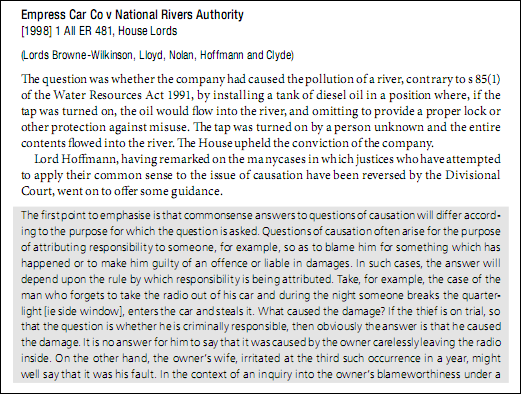
XML
      <p>
         <b>Empress Car Co v National Rivers Authority</b>
     </p>
      <p>
         <bibItem id="he-9780199289721-chapter-7-bibItem-999" class="case-ref" party1="Empress Car Co" party2="National Rivers Authority" idnumber="[1998] 1 All ER 481" date="1998">[1998] 1 All ER 481, House Lords</bibItem>
     </p>
      <p>(Lords Browne-Wilkinson, Lloyd, Nolan, Hoffmann and Clyde)</p>
      <p>The question was whether the company had caused the pollution ... offer some guidance.</p>
      <p>
         <extract id="he-9780199289721-chapter-7-extract-1" class="case-ref" party1="Empress Car Co" party2="National Rivers Authority" idnumber="[1998] 1 All ER 481" date="1998"><textMatter>
 <p>The first point to emphasise is that common sense answers to questions of causation
              will differ according to the purpose for which the question is asked. Questions of
              causation of ... </p></textMatter>
        </extract>
      </p>