Capturing non-multiple-choice questions
Non-multiple-choice questions are sometimes called “discussions.” They start with a scenario which is followed by several, enumerated discussion points, giving them the appearance of multiple-choice questions. But the answers, if there are any, contain only explanations, not definitive answers.
|
Q |
A question in a list of questions |
|
A |
An answer in a list of answers |
Capture non-multiple-choice questions as normal, structured XML. Capture the p element(s) that contains the question with attribute role="question". Capture the p element(s) that contains the answer with attribute role="answer".
If the questions and answers are in separate div[1-7,N] elements, give attribute role="Q" to the div[1-7,N] element containing the questions and attribute role="A" to the div[1-7,N] element containing the answers.
Non-multiple-choice questions in a single section
XML
      <div1 doi="10.1093/med/9780198739685.003.0001.021.0018" id="med-9780198739685-chapter-1-div1-18">
        <titleGroup id="med-9780198739685-chapter-1-titleGroup-38"><title id="med-9780198739685-chapter-1-title-111">
 <p id="med-9780198739685-chapter-1-p-627">Sample questions</p></title>
        </titleGroup>
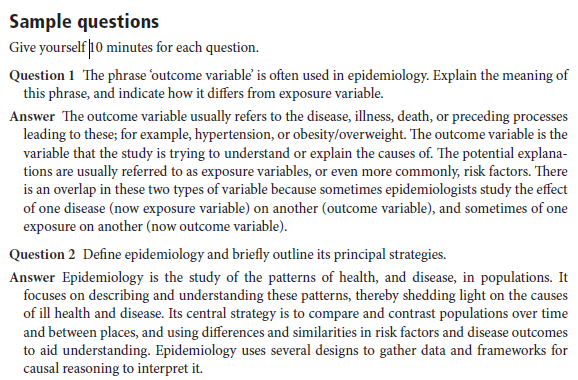
        <p fullOut="Y" id="med-9780198739685-chapter-1-p-628">Give yourself 10 minutes for each
          question.</p>
        <p id="med-9780198739685-chapter-1-p-629" role="question">
                 <b>Question 1</b> The phrase
          ‘outcome variable’ is often used in epidemiology. Explain the meaning of this phrase, and
          indicate how it differs from exposure variable.</p>
        <p id="med-9780198739685-chapter-1-p-630" role="answer">
                 <b>Answer</b> The outcome variable
          usually refers to the disease, illness, death, or preceding processes leading to these;
          for example, hypertension, or obesity/overweight. The outcome variable is the variable
          that the study is trying to understand or explain the causes of. The potential
          explanations are usually referred to as exposure variables, or even more commonly, risk
          factors. There is an overlap in these two types of variable because sometimes
          epidemiologists study the effect of one disease (now exposure variable) on another
          (outcome variable), and sometimes of one exposure on another (now outcome variable).</p>
        <p id="med-9780198739685-chapter-1-p-631" role="question">
                 <b>Question 2</b> Define
          epidemiology and briefly outline its principal strategies.</p>
        <p id="med-9780198739685-chapter-1-p-632" role="answer">
                 <b>Answer</b> Epidemiology is the
          study of the patterns of health, and disease, in populations. It focuses on describing and
          understanding these patterns, thereby shedding light on the causes of ill health and
          disease. Its central strategy is to compare and contrast populations over time and between
          places, and using differences and similarities in risk factors and disease outcomes to aid
          understanding. Epidemiology uses several designs to gather data and frameworks for causal
          reasoning to interpret it.</p>
      </div1>
Non-multiple-choice questions in separate sections
XML
      <div1 doi="10.1093/med/9780195314465.003.0011.021.0519" id="med-9780195314465-chapter-11-div1-519" role="Q">
        <titleGroup><title>
 <p>Questions</p></title>
        </titleGroup>
        <p><list class="other">
 <list1 listType="structured">
   <item1>
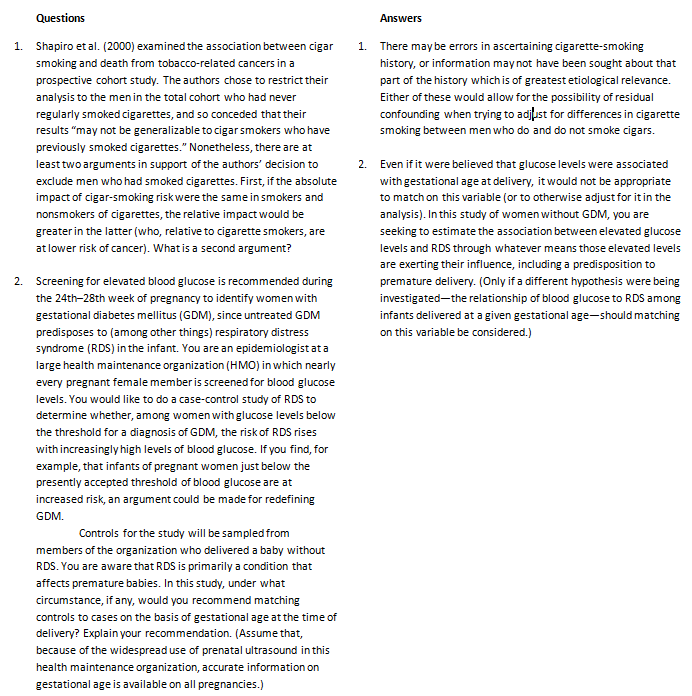
     <p role="question">
                                 <enumerator>1</enumerator>. <xrefGrp>
                                     <xref ref="med-9780195314465-chapter-11-bibItem-13">Shapiro <i>et al</i>.
                      (2000)</xref>
                                 </xrefGrp> examined the association between cigar smoking and
                  death from tobacco-related cancers in a prospective cohort study. The authors
                  chose to restrict their analysis to the men in the total cohort who had never
                  regularly smoked cigarettes, and so conceded that their results “may not be
                  generalizable to cigar smokers who have previously smoked cigarettes.”
                  Nonetheless, there are at least two arguments in support of the authors’ decision
                  to exclude men who had smoked cigarettes. First, if the absolute impact of
                  cigar-smoking risk were the same in smokers and nonsmokers of cigarettes, the
                  relative impact would be greater in the latter (who, relative to cigarette
                  smokers, are at lower risk of cancer). What is a second argument?</p>
   </item1>
   <item1>
     <p role="question">
                                 <enumerator>2</enumerator>. Screening for elevated blood glucose
                  is recommended during the 24th–28th week of pregnancy to identify women with
                  gestational diabetes mellitus (GDM), since untreated GDM predisposes to (among
                  other things) respiratory distress syndrome (RDS) in the infant. You are an
                  epidemiologist at a large health maintenance organization (HMO) in which nearly
                  every pregnant female member is screened for blood glucose levels. You would like
                  to do a case-control study of RDS to determine whether, among women with glucose
                  levels below the threshold for a diagnosis of GDM, the risk of RDS rises with
                  increasingly high levels of blood glucose. If you find, for example, that infants
                  of pregnant women just below the presently accepted threshold of blood glucose are
                  at increased risk, an argument could be made for redefining GDM.</p>
     <p role="question">Controls for the study will be sampled from members of the
                  organization who delivered a baby without RDS. You are aware that RDS is primarily
                  a condition that affects premature babies. In this study, under what circumstance,
                  if any, would you recommend matching controls to cases on the basis of gestational
                  age at the time of delivery? Explain your recommendation. (Assume that, because of
                  the widespread use of prenatal ultrasound in this health maintenance organization,
                  accurate information on gestational age is available on all pregnancies.)</p>
   </item1>
 </list1></list>
        </p>
      </div1>
      <div1 doi="10.1093/med/9780195314465.003.0011.021.0520" id="med-9780195314465-chapter-11-div1-520" role="A">
        <titleGroup><title>
 <p>Answers</p></title>
        </titleGroup>
        <p><list class="other">
 <list1 listType="structured">
   <item1>
     <p role="answer">
                                 <enumerator>1</enumerator>. There may be errors in ascertaining
                  cigarette-smoking history, or information may not have been sought about that part
                  of the history which is of greatest etiological relevance. Either of these would
                  allow for the possibility of residual confounding when trying to adjust for
                  differences in cigarette smoking between men who do and do not smoke cigars.</p>
   </item1>
   <item1>
     <p role="answer">
                                 <enumerator>2</enumerator>. Even if it were believed that glucose
                  levels were associated with gestational age at delivery, it would not be
                  appropriate to match on this variable (or to otherwise adjust for it in the
                  analysis). In this study of women without GDM, you are seeking to estimate the
                  association between elevated glucose levels and RDS through whatever means those
                  elevated levels are exerting their influence, including a predisposition to
                  premature delivery. (Only if a different hypothesis were being investigated—the
                  relationship of blood glucose to RDS among infants delivered at a given
                  gestational age—should matching on this variable be considered.)</p>
   </item1>
 </list1></list>
        </p>
      </div1>